From the Stands
Rumi
1207–1273
- Lived
- 1207–1273
- Place
- Balkh and Konya
- Teacher
- Shams of Tabriz
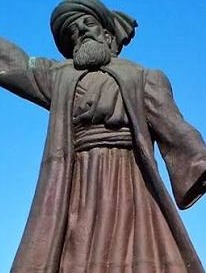
Portrait: a later depiction
What the Masnavi talks about
The Masnavi-yi Ma‘navi, “Rhyming Couplets of Inner Meaning,” is a poem of about 25,000 couplets in six books, which Rumi dictated to his disciple Husam al-Din Chalabi over his last fifteen years. It is so steeped in the Quran that it has been called “the Quran in the Persian tongue.”
It opens with a reed. “Listen to the reed, how it tells a tale, complaining of separations.” Cut from its reed-bed, the reed flute cries for home. The soul is that reed: cut off from its origin, it longs to return, and its longing is love.
It teaches through stories. Instead of argument, Rumi tells hundreds of tales, many of them comic, and draws a lesson from each, then a deeper lesson from that. The elephant in the dark, the merchant and his parrot, Moses and the shepherd: each opens onto how the soul finds God.
Love is the force that moves everything upward. The heavens turn on love, and the soul climbs by it. Intellect learned at school can only take a person so far; love goes the rest of the way.
The soul climbs through the levels of life. In a famous passage Rumi writes: “I died as mineral and became a plant; I died as plant and rose to animal; I died as animal and I was man. Why should I fear? When was I less by dying?” The self is not fixed: it grows, and its growth points beyond death.
Iqbal called Rumi his guide, and in his own Persian epic, the Javid Nama, Rumi leads him through the heavens.
In the first paragraph
Born in the region of Balkh, Rumi settled in Konya, in Anatolia, as a jurist and preacher. His meeting with the mystic Shams of Tabriz in 1244 turned him into a poet of divine love, and he wrote the Masnavi and the Divan-e Shams. He is the unnamed “great mystic poet of Islam” on page 4. He is studied mainly in Persian literature and Sufism, and he is not a philosopher in the strict sense, because he built no systematic argument.
The ladder he inherited. Greek thought left a picture of reality as a ladder. Aristotle contributed a highest being and a scale running from pure actuality down to changing matter. Plato contributed the idea that the soul must climb back up. Plotinus joined the two, picturing all things flowing from the One and longing to return. This picture reached Rumi indirectly, through Islamic philosophy and earlier Sufism, alongside the Quran’s own theme of return to God.
Love as the upward pull. Aristotle said the highest being moves the heavens as an object of love. Rumi says the heavens turn on waves of love, but his God loves in return. Love is broader than intuition: it is the force that draws a person toward God and opens the heart to knowing. His closest word for that knowing is dhawq, or “tasting.”
Two kinds of intellect. The Masnavi describes one intellect acquired like a boy at school, and another that is God’s gift, a spring within the soul. When Rumi attacks intellect, he usually means the first.
What it does
| Senses | Perceive the physical world |
| Partial intellect (‘aql-i juz’i) | Calculates and reasons from what the senses provide |
| Universal intellect (‘aql-i kull) | Stands high in the order of reality, close to God |
| Love and the heart | Carry the seeker past what reasoning can reach |
Thought sees only parts. In the Masnavi, people feel an elephant in a dark room. One touches the ear and calls it a fan, and another touches the leg and calls it a pillar. With a candle, their disagreement would disappear.
The ladder in two pictures
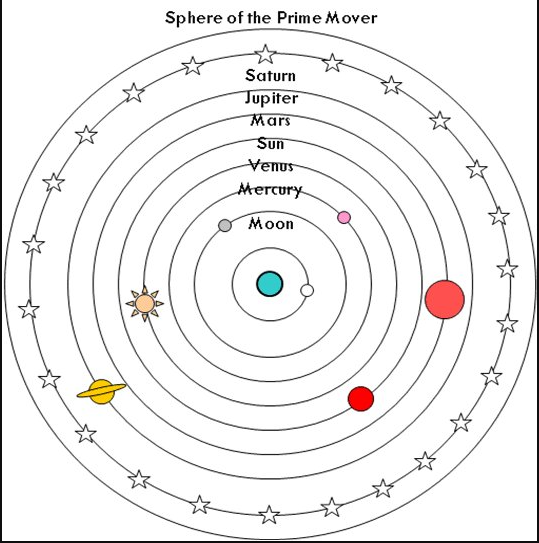
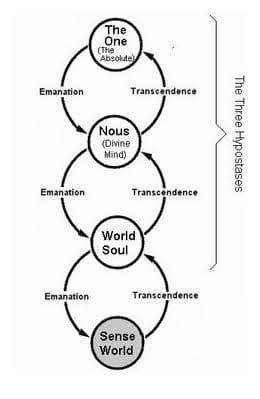
| Aristotle’s cosmos. Earth at the center, surrounded by | Neoplatonism. Reality flows down by emanation |
| nested spheres. | and rises again. |
Reading Aristotle’s cosmos. Below the Moon, the four elements change, and things are born and die. Above it, the heavens are made of ether and only move in circles. The Unmoved Mover causes that motion by being desired. The picture labels an outer sphere for it, but for Aristotle the Mover itself has no matter and no place. This is a ranking of motion, and nothing flows out of the Mover.
Reading Neoplatonism. Plotinus turned Aristotle’s ladder into a flow. He placed the One above everything and demoted Aristotle’s thinking God to the second level, Nous. Each level comes from the one above it, and the sense world is the farthest from the source. The upward arrows are the return, and this is the journey that Sufi writers describe as driven by love.
Why this matters. On both pictures, the changing world sits at the bottom. Iqbal’s claim that the Quran is “anti-classical” challenges exactly that, because it treats change in nature as worthy of attention.
Where they appear
1. Religion and philosophy · 7. The Quran’s picture of the universe · 8. Inner experience as knowledge
Built by Umair Malik while studying Iqbal · Your Commentator