Foundations · Fourth Example
Descartes
René Descartes (1596–1650) · One thinker, three questions
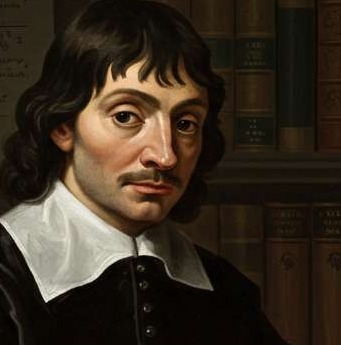
For Plato and Aristotle, the best human life was the mind turned toward forms. Descartes breaks with this. The forms leave nature, the world becomes a machine created by God, and reason’s task is to understand that machine and use it, first of all to end pain and illness. He was a mathematician and a scientist, not a man of politics. His starting point is not a shared world but his own mind, and his answers again follow the same order.
I. How We Know
A method
In the Discourse on Method (1637) Descartes gives four rules: accept nothing as true that you do not clearly know to be so; divide each problem into as many parts as possible; proceed in order from the simplest to the most complex; and review everything so that nothing is left out. His model is mathematics, the one field where reasoning reaches certainty. He invented analytic geometry, with its Cartesian coordinates.
Doubt and the one certainty
In the Meditations (1641) he tears down every belief that could possibly be false. The senses sometimes deceive. I might be dreaming. An evil demon might be fooling me even about mathematics. One thing survives every doubt: while I doubt, I am thinking, so I exist. “I think, therefore I am.” The first certainty in the universe is the self.
Clear ideas and God
From the certainty of the self he draws a test: whatever I perceive clearly and distinctly is true. But the test needs a guarantee, since the demon might corrupt even clear ideas. So he proves that God exists, and a perfect God would not deceive. Only then can he trust reason and rebuild the world. Arnauld objected that this is circular.
Some ideas are innate
Our ideas of God, of the self and of mathematical truths are not learned from the senses. They are born with the mind. In the second Meditation, a piece of wax loses its smell, color and shape when it is melted, yet we know it is the same wax. What we know is its extension, and we know it by the mind alone, not by the senses.
Deduction first, experiment second
Descartes hoped to derive physics from first principles, as geometry derives its theorems. But the further knowledge reaches into particular things, he admitted, the more it needs experiments, since different mechanisms could produce the same effect and only a test can decide. He even asked the public to help pay for them.
The individual as judge
A city planned by a single architect, Descartes writes, is better ordered than an old town built by many hands, and the same holds for knowledge. Truth is still the same for everyone, and “good sense is the best distributed thing in the world.” But each person must reach it alone, from the inside. Others no longer produce the truth through dialogue. They test what one mind has found, as one scientist repeats another’s experiment. He published his critics’ objections with his replies. In Socratic dialogue, truth was found between minds and the conversation was the method. In Cartesian meditation it is found within one mind, starting from one’s own existence, and others only test the result.
II. What Exists
Two kinds of substance
Descartes is the classic substance dualist. A substance is what needs nothing else in order to exist, so strictly only God qualifies, the infinite substance. Among created things there are two kinds, completely different in nature:
| Mind (res cogitans) | Body (res extensa) | |
|---|---|---|
| Essence | Thinking | Extension, taking up space |
| In space? | No | Yes |
| Divisible? | No. There is no half a mind | Yes, without end |
| How known | Directly and with certainty | Through ideas, with God’s guarantee |
| Governed by | Free will | Mechanical laws |
He argues for the split in three ways. I can doubt that my body exists but not that I am thinking. I can clearly conceive the mind without the body, and whatever I clearly conceive as separate, God could make separate. And the body can be divided while the mind cannot.
How mind and body meet
The two interact. My will moves my arm, and a wound causes my pain. Descartes placed the meeting point in the pineal gland in the brain, and he insisted on a close union: “I am not in my body merely as a pilot in a ship,” since a pilot sees damage to his ship while I feel pain in mine. In 1643 Princess Elisabeth of Bohemia asked how something without extension could move something extended, since pushing needs contact. His answers never satisfied her or later readers. This is the mind-body problem in its modern form, and the next generation answered it in very different ways:
| Answer | Who | Idea |
|---|---|---|
| Occasionalism | Malebranche | They do not interact. God moves the body on the occasion of the will |
| Parallelism | Leibniz | They do not interact. God set them running in step, like two clocks |
| One substance | Spinoza | Mind and body are two aspects of one substance, God or Nature |
| Materialism | Hobbes, La Mettrie | Only body exists, and the mind is part of the machine |
| Idealism | Berkeley | Only minds and their ideas exist |
Gilbert Ryle later called the Cartesian picture “the ghost in the machine”: a mind locked inside, a machine outside, and the puzzle of how they meet.
II. What Exists: The World as a Machine
The forms are gone
If the essence of body is extension alone, then matter has size, shape and motion and nothing else. There are no forms inside things and no purposes drawing them toward an end. Descartes thought the Aristotelian forms of the schools explained nothing, and he declared the search for final causes useless in physics. The rejection had begun before him, with the late medieval nominalists and with Galileo, who said the book of nature is written in mathematics. Descartes completed it. One trace of the old view remains: a triangle, he says, has “a true and immutable nature” that no one invented. He removed the sacred from inside nature, not from the world: God still creates and sustains the machine and gives it its laws, and the human mind stays free. Max Weber later called this process “the disenchantment of the world.”
Qualities move into the mind
Colors, sounds, tastes and warmth are not in things. They are sensations in the mind, produced by the motions of tiny particles. Only the mathematical qualities, extension and motion, belong to bodies. Locke later named the two kinds primary and secondary qualities.
From “why” to “how”
In his Meteorology (1637) Descartes explains water by its particles, which he imagined as long, smooth and flexible, like little eels sliding past one another, so that water flows. He still explains, but the kind of explanation has changed: not what a thing is for, but how its parts produce its behavior. Newton went further. His law of gravity (1687) states exactly how bodies attract one another, and he declined to say why: “I frame no hypotheses.”
| Who | The question | Water |
|---|---|---|
| Aristotle | What is it, and what is it for? | A cold, wet element in its natural place |
| Descartes and Newton | How does it work? | Particles sliding past one another |
| Modern science | What can we do with it? | Hydrogen and oxygen, joined and separated at will (Lavoisier, 1780s) |
A full world and its laws
Since space is simply extension, and extension is body, there is no void. The world is full, and matter moves in great whirlpools, or vortices, that carry the planets around the sun. God created matter and set it moving, and he keeps the total quantity of motion constant. Descartes stated laws of motion, including a principle of inertia, before Newton.
Animals and the body as machines
Animals have no minds. They are complex automata, like the moving statues in royal gardens that run on water pressure. The human body is the same kind of hydraulic mechanism, with “animal spirits” flowing through the nerves. Only the human mind stands outside the machine.
| Aristotle | Descartes | |
|---|---|---|
| Matter | Potential, waiting for form | Extension: size, shape and motion |
| Forms in things | Yes. They make things what they are | No |
| Purposes in nature | Yes. Each thing strives toward its end | None that physics can use |
| Colors and tastes | Real qualities of things | Sensations in the mind |
| Animals | Living things with souls | Machines |
| Model of science | Biology: watching things grow | Mathematics: deducing from clear principles |
III. How to Live
The tree of philosophy
In the preface to the Principles of Philosophy (1647) Descartes pictures philosophy as a tree. The roots are metaphysics: the self, God and the test of truth. The trunk is physics. The branches are medicine, mechanics and morals. Morals is “the highest and most perfect” science because it needs all the others, and so it comes last. He never completed it.
A provisional morality
While rebuilding knowledge he still had to live, so in the Discourse he adopted four temporary maxims, a house to live in while the new one was built. Obey the laws and customs of one’s country and follow the most moderate opinions. Be resolute once a decision is made, like a traveler lost in a forest who keeps walking in a straight line. Master oneself rather than fortune, changing one’s desires rather than the order of the world. And devote one’s life to cultivating reason. He wrote no political philosophy and kept clear of politics, and after Galileo’s condemnation in 1633 he held back his own book on the world.
Will, passions and generosity
Error and wrongdoing come from the same source: the will, which is unlimited, runs ahead of the intellect, which is limited. The cure is to hold back judgment until one sees clearly, then act firmly. Free will is our greatest perfection and the way we most resemble God. Happiness is contentment of mind, and it depends only on what is in our power, the use of our will. The passions are bodily motions felt by the soul. They are not evil, but they need governing, and they can be retrained by habit, as hunters train dogs. The chief virtue is generosity: knowing that nothing truly belongs to us except the free use of our will, and resolving to use it well. Since everyone has free will, the same knowledge grounds respect for others.
Masters and possessors of nature
The new science, Descartes writes, can make us “masters and possessors of nature.” This aim was new. Aristotle sought to understand nature, not to command it. Francis Bacon had just said that knowledge is power and that “nature, to be commanded, must be obeyed,” and Kant later wrote that reason must approach nature like a judge who compels a witness to answer. Descartes hoped the first fruit would be medicine, to free people from disease and even from the weakness of age, and he held that we are bound to procure “the general good of all men.” The aim is well-being. Happiness, for Descartes, remains inner contentment. Because nature has no purposes, inquiry has no point at which it is complete: each result opens new questions and new uses. Later critics, from Heidegger to Horkheimer and Adorno, traced the modern domination of nature back to this picture of matter as a resource without purpose of its own.
| Plato | Aristotle | Descartes | |
|---|---|---|---|
| The best life | Turning toward the Forms | Flourishing, crowned by contemplation | Self-mastery, and mastery of nature for human good |
| Center of ethics | The soul ordered by the Good | Character formed by habit, in a city | The individual will |
| Politics | Philosopher-kings | Citizens ruling in turn | Obey the customs and stay out |