Foundations · First Example
Plato
Plato (about 428–348 BCE) · One thinker, three questions
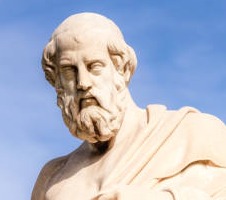
Plato’s philosophy is the clearest example of the three questions depending on one another. His answer about knowledge requires an answer about what exists, and both decide how he thinks we should live. The next four pages follow that order.
I. How We Know
What “knowledge” means
In philosophy, knowledge is not information but a belief that is true and properly grounded. Plato contrasts epistēmē, knowledge, with doxa, opinion. An opinion may happen to be true, but it is unstable and cannot give its reasons. In the Theaetetus he tests the idea that knowledge is “true belief with an account,” a belief you can explain and defend. The dialogue ends without settling the question, but this became the classic definition: knowledge is justified true belief.
Why the senses cannot give knowledge
From Heraclitus Plato took the view that the physical world is in constant change. Something that keeps changing cannot be known, because by the time we grasp it, it has become something else. So the senses give only opinion. Knowledge must be of what does not change, and only reason can reach it.
Recollection
How do we come to know unchanging truths at all? Plato’s answer is that the soul saw them before birth. In the Meno, Socrates questions an uneducated slave boy, who works out a geometrical truth that no one taught him. Learning, on this view, is remembering.
The divided line and the cave
In the Republic Plato ranks the stages of knowing as a line divided into four parts. The two upper stages deal with what can be grasped only by thought, and the two lower stages with what is seen, which yields only opinion:
| Stage | Its objects | Realm |
|---|---|---|
| Understanding (noēsis) | The Forms, up to the Good, reached by dialectic | Intelligible |
| Reasoning (dianoia) | Mathematical objects, reached through diagrams and assumptions | Intelligible |
| Belief (pistis) | Physical things | Visible |
| Imagining (eikasia) | Shadows, reflections and images | Visible |
Mathematics is the training ground. No perfect circle exists in nature, yet geometry knows the circle exactly. But it still relies on diagrams and on assumptions it does not prove, so it is not the top. Above it is dialectic, disciplined question and answer that tests every assumption and rises to the Form of the Good. The Good is to knowledge what the sun is to sight: it makes everything else both visible to the mind and real.
The allegory of the cave pictures the whole journey. Prisoners chained in a cave take shadows on the wall for reality. One is freed, turns around, climbs out and finally sees the sun. Education is not putting knowledge into the soul but turning the soul around to face what is real.
II. What Exists
The Forms
If knowledge is possible, its objects must exist. So there are Forms: Justice itself, Beauty itself, Equality itself, the Triangle itself, with the Good at the top. They are eternal, unchanging and independent of any mind. Plato took the unchanging from Parmenides and the flux from Heraclitus, and gave each its own world: being belongs to the Forms, becoming to physical things. He would say he discovered the Forms. His critics say he invented them to escape change.
Realist, not idealist, and not a materialist
Plato is often called an idealist, because the Greek word for a Form, idea, became our “idea.” But in the technical sense he is a realist. The Forms do not depend on any mind and would exist if no one ever thought of them. They are not ideas in a head. The mind discovers them.
He was firmly not a materialist. In the Sophist he describes a “battle between gods and giants.” The giants hold that only what can be touched is real. The friends of the Forms hold that true reality is unseen and unchanging, and Plato is on their side. He does not deny the physical world, but he ranks it lower. His view is one of degrees of reality: what is unchanging is more real than what changes.
How things get their qualities
An apple is red because it participates in the Form of Redness, and round because it participates in Roundness. The physical apple is a meeting point where several Forms show up for a while. If every red thing were destroyed, Redness itself would remain. Plato was not sure there is a Form for everything. In the Parmenides he hesitates over Forms of mud, hair and dirt.
Substance and essence
The Greek word later translated “substance” is ousia, true being. Plato gives it to the Forms, not to physical things, so for him the Forms are the real substances and the apple is a passing copy. A thing’s essence, what it truly is, is the Form it copies. Aristotle reversed this, and the contrast shows what is distinctive in Plato:
| Plato | Aristotle | |
|---|---|---|
| Where forms are | Apart from things, on their own | Only in things |
| What is most real | The Forms | Individual things: this apple, this man |
| Red in an apple | The apple shares in Redness itself | Redness exists in the apple as one of its qualities |
| Essence | The Form the thing copies | The form inside the thing |
| Why things change | Their medium is unstable, and they fall short of the Forms | Each thing strives to realize its own form, as an acorn becomes an oak |
The Phaedo has a hint of Aristotle’s view: equal sticks and stones “strive” to be like the Equal itself but fall short. For Plato, though, the striving that matters belongs to the soul.
After Plato: who strives toward the highest good?
| Thinker | What strives toward the highest good | Moved by |
|---|---|---|
| Plato | Mainly the soul. Things fall short of the Forms | Love (eros) |
| Aristotle | Every natural thing toward its form, and the heavens toward the Unmoved Mover | Desire, “as the beloved moves the lover” |
| Plotinus | Everything that has flowed from the One turns back toward it | Contemplation and love |
| The Sufis | The whole universe returns to God | Love (‘ishq) |
II. What Exists: The Cosmos
How the world is made
In the Timaeus Plato tells how the ordered cosmos came about. Before order there were three things: the Forms as a model, the receptacle or space, the “nurse of becoming,” and the shifting copies that appear in it. The receptacle held only traces of fire, water, earth and air, shaking without pattern like grain in a sieve. A divine craftsman, looking to the Forms, gave these traces geometric shape. Fire became tetrahedra, earth cubes, air octahedra and water icosahedra, and the dodecahedron served for the shape of the whole. Things appear in the receptacle, like images in a mirror, rather than being made out of it. Aristotle later read it as his “matter.”
The World-Soul
The universe is not a machine but a living animal, and so it has a soul. The craftsman made the World-Soul before the world’s body, mixing it from Being, Sameness and Difference, which places it between the unchanging Forms and the changing world. He divided the mixture by musical ratios, formed it into two bands crossed like an X, and bent them into circles: the circle of the Same carries the fixed stars, and the circle of the Different carries the planets. The World-Soul has several tasks:
| Task | What it does |
|---|---|
| Moves | Turns the heavens in circles, the motion closest to reason, because it stays in place and returns to itself |
| Knows | Judges what each thing is the same as and different from, giving knowledge of Forms and true opinion of physical things |
| Unifies | Runs through the whole body of the world and wraps it, making the cosmos one living whole |
| Makes time | The regular revolutions of the heavens are time, “a moving image of eternity” |
| Harmonizes | Its musical proportions order the cosmos, the origin of the “harmony of the spheres” |
Why the world needs a soul
The Forms are patterns that never act. The receptacle moves, but blindly. The craftsman makes the world once and then rests. Only the World-Soul is active, intelligent, present inside the world and always at work. Plato also holds that motion must begin in something that moves itself, which can only be a soul, and that intelligence can exist only in a soul. A building stands once it is finished. An animal stays itself only by living, and the World-Soul is the life of the cosmos. It does not need to climb toward the Forms as a human soul does, because it never fell and never forgets them. Its circling is its contemplation.
Is change aimless?
Partly. The world comes from two causes. Reason, through the craftsman and the World-Soul, arranges things for the best. Necessity, the “wandering cause,” is the blind motion of the receptacle. Reason “persuades” necessity, and what it cannot master remains as disorder, decay and chance. So change is aimed at the level of the whole and partly aimless in the material. Plato was in fact one of the first to demand explanations by purpose. In the Phaedo, Socrates complains that Anaxagoras said Mind orders everything and then explained things only by air and water.
III. How to Live
The soul is the true self
Socrates taught that what matters most is the care of the soul, and Plato made the soul the center of the person. It is immortal and existed before birth, which is what makes recollection possible. It is akin to the Forms: invisible, simple and able to know them. The body is its prison, and Plato repeats an old saying that the body (sōma) is a tomb (sēma). Philosophy is therefore “practice for dying,” the soul gradually freeing itself from the body’s distractions.
Each person has a soul of their own, with its own history, and the number of souls never changes. In the Timaeus the craftsman makes as many souls as there are stars, from what was left of the World-Soul’s mixture. The soul is not a Form, since Forms never move, while the soul thinks, desires and moves. It is “that which moves itself,” the source of all motion.
Rebirth and rank
In the Myth of Er at the end of the Republic, souls are judged and then choose their next lives, and each choice reflects the character formed before. “The responsibility is the chooser’s,” Plato writes, “God is blameless.” In the Phaedrus, souls are born into nine ranks of life, from the philosopher down to the tyrant, according to how much of the Forms they once saw. So a present life partly reflects the soul’s past. It is not a fixed sentence: in the Republic a child with gold in him rises to rule whoever his parents are, and every life is a chance to turn toward the Good.
The parts of the soul and the role of love
The soul has three parts: reason, spirit and appetite. In the Phaedrus it is a charioteer driving two horses, one noble and one unruly that drags it toward appetite. The soul rises through love (eros). In the Symposium, Diotima describes love as the desire to possess the good forever. It climbs a ladder from one beautiful body to all beauty, to beautiful souls and laws, to knowledge, and finally to Beauty itself. Being born throws the soul’s circles of thought into disorder, and the cure is to study the heavens until our thinking falls back into step with the World-Soul.
Virtue and the Good
A soul is just when reason, knowing the Good, rules spirit and appetite. Virtue is knowledge: whoever truly knows the good will do it, so wrongdoing comes from ignorance.
The city
In the Republic the city mirrors the soul. Those who know the Good, the philosopher-kings, must rule, supported by guardians and producers. A “myth of the metals,” the “noble lie,” teaches that some people have gold in them, some silver and some bronze. The poets are censored because their stories can corrupt. Karl Popper (1945) saw in this the root of authoritarian rule. Defenders read the ideal city mainly as a picture of the well-ordered soul.