From the Stands
Johann Wolfgang von Goethe
1749–1832
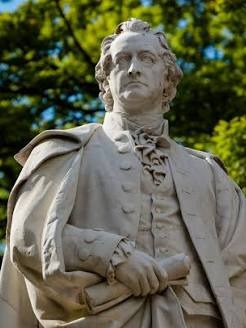
- Lived
- 1749–1832
- Place
- Weimar
What Faust talks about
Faust is a play in two parts that Goethe worked on for about sixty years. Part One appeared in 1808, and Part Two in 1832, the year he died.
A scholar who knows everything and has learned nothing. Faust has mastered philosophy, law, medicine and theology, and finds it all dead: “Here I stand, poor fool, no wiser than before.” Books have given him knowledge, but not life.
The wager. He makes a bet with Mephistopheles, the devil. If Faust ever becomes content and says to a passing moment, “Stay, you are so beautiful,” the devil may take his soul. Faust is betting that he will never stop striving.
“In the beginning was the Deed.” Translating the opening of John’s Gospel, “In the beginning was the Word,” Faust tries “Mind,” then “Power,” and settles on “Deed.” Action, not words or thought alone, is where life begins.
The journey. Part One follows his love for Gretchen, which ends in her ruin. Part Two takes him through the imperial court, the classical world of Greece, and finally a great project to win land from the sea for free people to live on.
The ending. Faust is saved, not because he was good, but because he never stopped striving: “Whoever strives, always working, him we can redeem.”
Iqbal admired Goethe deeply. His Payam-e-Mashriq (1923) was written as an answer to Goethe’s West-Eastern Divan, and the restless, striving self of Faust is close to Iqbal’s own picture of the human ego.
In the fifth paragraph
Germany’s greatest literary figure and the author of Faust. He took a serious interest in Islam, and his West-Eastern Divan (1819) was inspired by the Persian poet Hafiz.
Where they appear
1. Religion and philosophy · 5. The Quran’s purpose
Built by Umair Malik while studying Iqbal · Your Commentator