Foundations · Third Example
Ghazali
Abu Hamid al-Ghazali (1058–1111) · One thinker, three questions
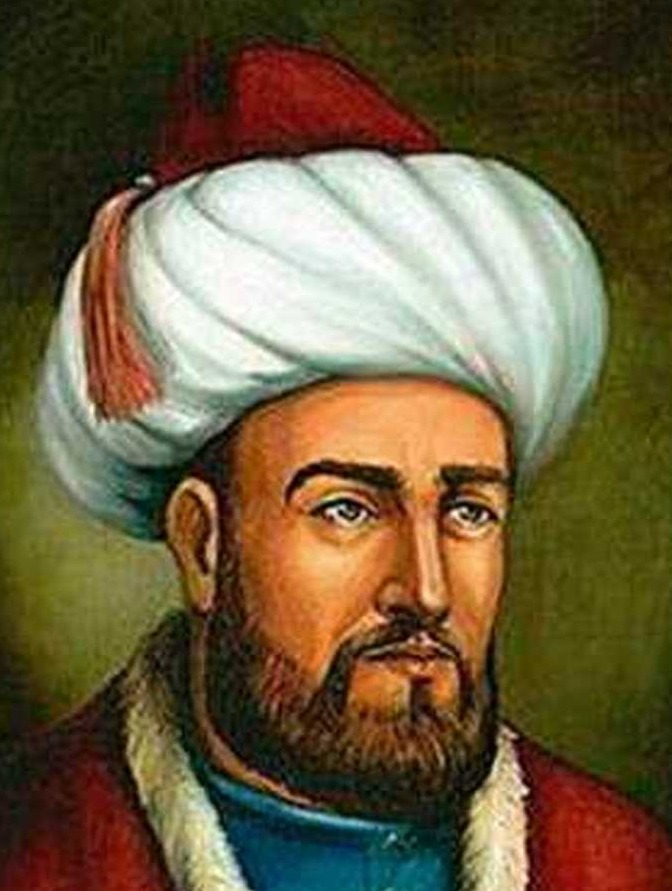
Ghazali was born in Tus, in Persia, and by 1091 headed the Nizamiyya college in Baghdad, the most prestigious post in the Islamic world. In 1095 a spiritual crisis left him unable to speak or teach. He gave up his post and spent about ten years in Sufi retreat and travel, then taught again before his death. Aristotle reached him through the Muslim philosophers al-Farabi and Ibn Sina, and he answered their philosophy from within. He is known as Hujjat al-Islam, “the Proof of Islam.” His answers follow the same order.
I. How We Know
The search for certainty
In his autobiography, Deliverance from Error, Ghazali says he wanted knowledge so certain that no doubt could touch it. If someone claimed that three is more than ten and proved it by turning a stick into a snake, he would marvel at the trick but would not doubt that ten is more than three. That is the kind of certainty he was looking for.
Doubt of the senses and of reason
The senses fail the test. A shadow looks still but moves, and a star looks as small as a coin, though geometry shows it is larger than the earth. Reason corrects the senses, but what corrects reason? Perhaps there is a judge above reason, as reason is above the senses. In dreams we believe everything we see, until we wake. Perhaps waking life is a dream compared with some higher state, as the saying goes: “People are asleep, and when they die they awake.” For about two months, he writes, he doubted everything. He was cured not by an argument but “by a light which God cast into the breast.”
| Ghazali | Descartes | |
|---|---|---|
| Doubts | The senses, reason, waking life itself | The senses, dreams, even mathematics, through an evil demon |
| What ends the doubt | A light from God, not an argument | An argument: “I think, therefore I am” |
| Where certainty is finally found | Direct experience of God | Clear ideas in one’s own mind, with God’s guarantee |
Four groups of seekers
He then examined everyone who claimed to have the truth. The theologians defended belief well, but they argued from their opponents’ premises and never reached first principles. The philosophers he studied for years, summarized faithfully in The Aims of the Philosophers, and then refuted. He rejected their metaphysics but kept their logic, a neutral tool in his view, and brought it into Islamic law and theology. The Batinites taught that truth comes only from an infallible hidden Imam, which he rejected. The Sufis had what the others lacked: a path of experience.
Knowing by tasting
There are three ways of knowing, Ghazali says: by demonstration, by accepting it on trust, and by dhawq, “tasting.” Knowing the definition of drunkenness is very different from being drunk, and knowing what health is differs from being healthy. Beyond reason lies prophecy, a faculty that sees what reason cannot, just as reason sees what the senses cannot. A child gains the senses, then discernment around the age of seven, then intellect, and prophecy is a stage beyond intellect.
II. What Exists
The Incoherence of the Philosophers
In The Incoherence of the Philosophers (around 1095), Ghazali uses the philosophers’ own logic against them. His targets are al-Farabi and above all Ibn Sina, who had built a system out of Aristotle and Plotinus. In it, God is the Necessary Being, and the world flows from God eternally and necessarily, through a chain of intellects, as light flows from the sun. Ghazali examines twenty of their claims. He calls seventeen of them errors and three of them unbelief: that the world is eternal, that God knows only universals and not particular things, and that bodies are not resurrected.
A world created by will
For Ghazali the world had a beginning, and time began with it. The philosophers asked why God would create at one moment rather than another, since all moments are alike. Ghazali answers that this is exactly what a will does: it chooses between alternatives that are equal. A hungry man offered two identical dates simply takes one. God is not a sun that shines because it must, but an agent who acts by choice.
Causes are God’s habit
When fire touches cotton, the cotton burns. The philosophers said fire burns by its own nature, of necessity. Ghazali replies that we observe only that the two happen together, never that one makes the other happen. It is God who creates the burning each time, and the regularity we see is God’s custom (‘āda). God could break it, as when Abraham was not burned by the fire. The theologians of his school, the Ash‘arites, held that the world consists of atoms and of qualities that do not last two moments, so God creates them anew at every instant.
Seven centuries later David Hume made a similar point: we see one event follow another but never the necessary connection between them. The difference is where the regularity lives. For Hume it is a habit of our minds. For Ghazali it is the habit of God.
God and the soul
God knows every particular thing, and “not an atom’s weight escapes Him.” The human soul is a spiritual reality, which Ghazali calls the heart, the spirit and the soul. It survives death, and at the resurrection it is joined again to a body.
| Aristotle and Ibn Sina | Ghazali | |
|---|---|---|
| The world | Eternal, without a beginning | Created, with a beginning in time |
| How it comes from God | Necessarily, as light from the sun | By God’s free choice |
| Cause and effect | Necessary connections in the nature of things | God’s custom, which God could break |
| What God knows | Universals only (Ibn Sina) | Every particular |
| Life after death | The soul alone | Soul and body together |
III. How to Live
The revival of religious knowledge
After his crisis Ghazali wrote his largest work, The Revival of the Religious Sciences, in forty books and four parts: acts of worship, the customs of daily life, the vices that destroy, and the virtues that save. His aim was to bring the inner life back into a religion he thought had become a matter of legal rules and debate. A shorter Persian version, The Alchemy of Happiness, opens with a principle: whoever knows himself knows God.
The heart as a mirror
The heart is like a mirror. When it is rusted by vices and worldly desire, it reflects nothing. When it is polished by discipline and remembrance of God, the realities of things show in it. So knowledge of God is not mainly a matter of argument. It comes when the heart is cleaned.
Disciplining the soul
Here Ghazali takes over the Greek inheritance and gives it a new aim. The soul has the powers of reason, anger and desire, as in Plato. Each is good when it is balanced: reason becomes wisdom, anger becomes courage, desire becomes temperance, and their right order is justice. Each virtue is a middle course between too much and too little, as in Aristotle. But the purpose of the virtues is now nearness to God.
| The vices that destroy | The virtues that save |
|---|---|
| Greed and the appetites | Repentance |
| Anger, hatred and envy | Patience and gratitude |
| Love of wealth and love of status | Fear and hope |
| Showing off and pride | Trust in God (tawakkul) |
| Self-deception | Love of God, sincerity and remembrance of death |
Knowledge and action
Knowledge without action is useless, and action without knowledge is blind. What counts is intention and sincerity, doing a thing for God alone. The highest happiness is the vision of God in the life to come, and the highest station in this life is the love of God.
Rulers and scholars
Ghazali defended the authority of the caliph against the Batinites, holding that even an imperfect order is better than chaos. After his crisis he turned away from the courts. He later recalled vowing at the tomb of Abraham in Hebron never again to serve a ruler, accept a ruler’s gifts or take part in public debates.