Foundations · Second Example
Aristotle
Aristotle (384–322 BCE) · One thinker, three questions
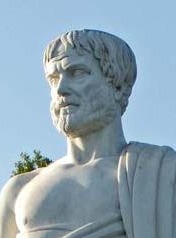
Aristotle studied in Plato’s Academy for twenty years and then reversed much of what he learned. Where Plato looked past the changing world, Aristotle looked into it. His answers depend on one another just as closely, and the next four pages follow the same order as Plato’s.
I. How We Know
Knowledge begins with the senses
The Metaphysics opens: “All men by nature desire to know,” and the evidence Aristotle gives is our delight in seeing. Knowledge grows in stages. Perception leaves memories, many memories of the same thing make up experience, and experience gives rise to craft and science. A doctor with experience knows that a remedy helped Callias and Socrates. A doctor with science knows why it helps everyone with that illness. To know, for Aristotle, is to know the cause.
Induction and insight
From many particular cases the mind rises to the universal. This is induction (epagōgē). The first principles of a science cannot themselves be proved, so they are grasped by a direct insight of the intellect (nous), which sees what the many cases have in common. There is no recollection of a life before birth. The mind starts as a blank tablet, and everything it knows begins in perception.
Logic
Aristotle invented formal logic, later collected as the Organon, the “instrument” of thought. Its core is the syllogism: “All humans are mortal. Socrates is human. So Socrates is mortal.” Scientific knowledge (epistēmē) derives necessary conclusions in this way from first principles.
The kinds of knowledge
Knowledge is theoretical, sought for its own sake: first philosophy or theology, mathematics and physics. It is practical, aimed at acting well: ethics and politics, guided by practical wisdom (phronēsis). Or it is productive, aimed at making: the crafts (technē).
He ranks the theoretical sciences from the eternal and unchanging down to physics. So he studies change in order to find what does not change: the changing particular is the way in, and the form or cause is what is finally known. Against Plato, knowing starts from perception, not recollection; its method is observation, induction and logic, not dialectic; and the changing world is the road to knowledge of causes, not a source of mere opinion.
Observation, not experiment
Aristotle observed nature more closely than anyone before him, but he did not set up experiments to test it. Knowing aimed at understanding, not control, and contemplation ranked above making, so inquiry had a natural end: once the causes are seen, the mind rests in contemplating them. Science continued after him, in Alexandria and in the Islamic world, where Ibn al-Haytham ran controlled experiments in optics around 1011–1021.
II. What Exists
Substance
In the Categories, the primary substance is the individual thing: this man, this horse, this oak. A substance exists in its own right. Everything else exists in a substance or is said of it, and Aristotle sorts these into categories: quantity, quality, relation, place, time, position, state, action and being acted on. Redness is a quality, and it can exist only as the redness of something. A substance has an essence, what it must be to be what it is, and accidents, what it happens to be. Socrates is essentially a rational animal and only accidentally pale. He stays Socrates when the paleness goes.
Form and matter
Every natural substance is form in matter. This view is called hylomorphism, from hylē, matter, and morphē, form. Its essence is its form, and the form exists only in the matter it shapes, like the shape of a seal pressed into wax. Matter is not a kind of stuff but a role: whatever can take on a form. It comes in layers:
| Thing | Its matter |
|---|---|
| A statue | Bronze |
| An animal | Flesh and bones |
| Bronze, flesh and bones | The four elements: earth, water, air and fire |
| Each element | Prime matter given a pair of qualities, such as fire, which is hot and dry |
| Prime matter | Nothing further. It has no form, only the capacity to become anything, and never exists on its own |
Matter is also what makes individuals. Socrates and Callias share one form, human, and are two people because their matter is different. It resists form too, which is the source of chance and defects, and it cannot be known by itself, only through the forms it takes.
Potential and actual
Parmenides had argued that change is impossible, because something would have to come from nothing. Aristotle answers that an acorn is potentially an oak. Change is that potential being realized, and nothing comes from nothing, because the oak was already there as a potential. Form is actuality and matter is potentiality.
The four causes
| Cause | Question it answers | For an oak |
|---|---|---|
| Material | What is it made of? | Wood, from the elements |
| Formal | What is it? | The form “oak” |
| Efficient | What started the change? | The parent oak that dropped the acorn |
| Final | What is it for? | The mature oak, the end of growth |
In nature the formal, efficient and final causes often coincide. “The nature of a thing is its end”: to know what an acorn is, watch what it becomes. That is why Aristotle became a working biologist, dissecting animals and studying hundreds of species.
Take water. Aristotle would not ask what it is made of, since water is itself one of the four elements, cold and wet by nature. He would ask what it is, where it belongs, between earth and air, and how it comes to be and passes away. To understand water is to see its nature and its place in the ordered whole.
II. What Exists: The Cosmos
Place, not space
Aristotle has no empty space stretching without end. He has place, which he defines as “the innermost motionless boundary of the containing body.” A fish’s place is the inner surface of the water around it. A boat in a flowing river has the river as a whole for its place, the boundary that stays put. Place is neither form nor matter, since a thing can leave its place but not its matter. Here Aristotle separates what Plato’s receptacle had merged: matter is what a thing is made of, and place is where it is. He even says Plato identified the two.
No void, and a finite world
Empty space is impossible. In a void nothing would resist motion, so a body would move infinitely fast, and there would be no reason for it to stop in one place rather than another. The world is therefore full. It is also finite. It ends at the outermost sphere, and beyond it there is no place, no void and no time.
Natural places
Each element has a natural place and moves toward it by nature. Earth moves to the center, water settles above it, then air, and fire rises toward the Moon. That is why a stone falls and a flame rises. Below the Moon, things are born and die. Above it, the heavens are made of ether, a fifth element that cannot be created or destroyed, and their only change is eternal circular motion. Time is “the number of motion,” the measure of change, so without change there would be no time.
The Unmoved Mover
Every motion needs a source, and the chain cannot go back forever. At its head is the Unmoved Mover: pure actuality, with no matter and no unrealized potential, so it never changes. It does not push the heavens. It moves them “as the beloved moves the lover,” by being desired. Its life is thought, and since the best object of thought is itself, it is “thought thinking itself.” In Metaphysics XII Aristotle even counts some forty-seven or fifty-five such movers, one for each heavenly sphere.
Purpose in nature
“Nature does nothing in vain.” Each natural thing has an inner source of change and rest, and its development aims at its form. So change is not aimless, and Aristotle needs no World-Soul. Plato’s Forms only served as models, so a soul had to animate the world. Aristotle’s forms act from inside things, and the Unmoved Mover draws the whole cosmos by attraction.
| Plato | Aristotle | |
|---|---|---|
| What things are made of | Copies appearing in the receptacle | Form in matter |
| Space | The receptacle is space | Place, the boundary of what surrounds a body |
| What moves the cosmos | The World-Soul | Natures within things, and the Unmoved Mover by being desired |
| Why things change | Their medium is unstable, and they fall short of the Forms | They strive to realize their own forms |
III. How to Live
Flourishing
Everyone agrees that the highest good is eudaimonia, flourishing or happiness, but people disagree about what it is. Aristotle answers by asking what a human being is for. A knife is good if it cuts well, and a human is good if he does well what is distinctive of humans, which is living by reason. So flourishing is the activity of the soul in accordance with virtue, over a complete life. It is something you do, not a feeling you have.
Virtue as habit
Plato said that whoever knows the good will do it. Aristotle disagrees: people can know what is right and still fail to do it, which he calls weakness of will. Moral virtue is a settled habit formed by practice. “We become just by doing just acts,” as we become builders by building. Each virtue is a mean between two extremes:
| Too little | The virtue | Too much |
|---|---|---|
| Cowardice | Courage | Recklessness |
| Stinginess | Generosity | Extravagance |
| Self-deprecation | Truthfulness | Boastfulness |
The mean is not the same for everyone. Finding it in each situation takes practical wisdom (phronēsis), which comes only with experience. That is why the young can be good at mathematics but cannot yet be practically wise.
The soul and this life
The soul is the form of the living body. Plants have its nourishing level, animals add perception and movement, and humans add reason. Since a form cannot exist apart from its matter, the soul does not survive the body. The one possible exception is the active intellect, and it is not clear that it would remain personal. There is no rebirth and no earlier life. Virtue is formed in this life alone.
Not everyone can flourish
Aristotle does not think the good life is open to all equally. Upbringing “makes all the difference,” because habits are formed in youth under good parents and good laws. Flourishing also needs some external goods, such as friends, health and moderate wealth, and great misfortune can ruin a good life, as it did for King Priam of Troy. At its darkest, his view excluded some people from full virtue altogether, defending what he called natural slavery.
Contemplation and the city
The highest life is contemplation (theōria), the activity closest to the divine, and the practical life of virtue is a close second. Humans are “political animals,” and the city exists for the sake of living well. Against Plato, Aristotle rejects philosopher-kings and shared property. He prefers a mixed constitution with a strong middle class, in which citizens take turns “ruling and being ruled.” The model statesman is Pericles, a man of practical wisdom, not a theorist like Thales.