Setting Up the Board
Socrates
c. 470–399 BCE
- Lived
- c. 470–399 BCE
- Place
- Athens
- Principal move
- Set the moves going
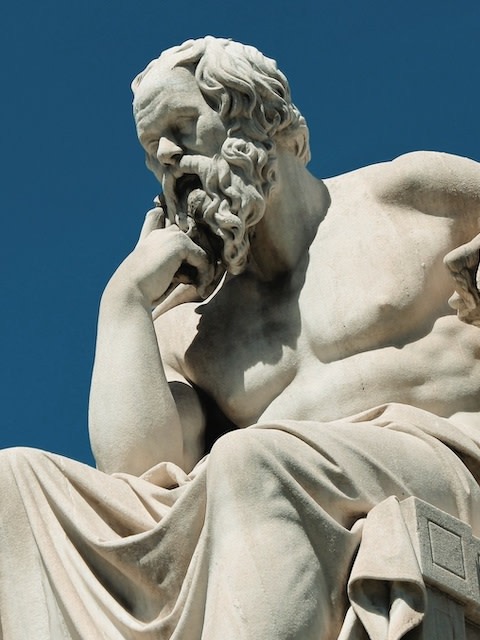
Portrait: a later depiction
Where it all starts
Socrates wrote nothing, and he played no match. He arranged none of the pieces: no theory of knowledge, no account of what exists, no system of ethics. What he did was show that the old arrangement was in check, and set up the board on which every later match would be played.
What he inherited
Athens already had an arrangement of the pieces, though not a philosopher’s.
| Piece | The inherited answer |
|---|---|
| Epistemology | You know because the poets, the elders and custom tell you. Homer and Hesiod were the textbooks. |
| Metaphysics | The gods and the myths, and the guesses of the first philosophers of nature: everything is water (Thales), everything flows (Heraclitus), nothing changes (Parmenides). |
| Ethics | Do what custom (nomos) and the gods require. |
The rest moves
In the 400s BCE that arrangement came under strain. Greeks who travelled and traded saw that every city had its own customs and its own gods: what was just here was unjust there. The Sophists drew the conclusion. Protagoras said that “man is the measure of all things”: there is no single truth, only persuasion. The long war with Sparta, and the swings of the Athenian assembly, showed how easily people could be argued into anything. The king was in check. Custom no longer told an Athenian what to do, and the Sophists said that nothing could.
He shows the check
Socrates went about the marketplace asking one question, “What is X?”: what is courage, piety, justice, virtue. Every confident answer fell under questioning, because it contradicted something the speaker already believed. Euthyphro hurries away, the two generals in the Laches cannot say what courage is. The inherited arrangement was shown to be inconsistent, in public, one citizen at a time. What remained was his own wisdom: he knows that he does not know.
He sets up the board
In doing this, Socrates laid down the rules every later match would play by.
- An answer must be consistent. A definition is dropped as soon as it contradicts something the speaker already accepts. This is his method of questioning, the elenchus.
- An answer must be universal. He refuses lists of cases. In the Euthyphro he asks for “that form itself by which all pious things are pious,” and in the Meno for what all bees share, however much they differ. He even separates what a thing is from what merely happens to it: being loved by the gods happens to piety, but does not say what piety is.
- An answer must be defended by reason, not by authority, custom or the poets. Aristotle credits Socrates with exactly two things: “inductive arguments and universal definition.”
- The answer is reached together. Socrates never thinks alone. He calls himself the city’s “gadfly,” stinging a sluggish horse awake (Apology). You find out what you believe only when someone questions you, and because people live together, the truth has to be something they can reach together.
- Knowing that you do not know is where the game starts.
A seed on each piece
| Piece | What Socrates left |
|---|---|
| Epistemology | Knowledge must be a definition that survives every test. He never says where it comes from. |
| Metaphysics | He takes it for granted that “what X is” is something real and one, without saying what kind of thing. In the Phaedo he says he turned away from the philosophers of nature in disappointment: Anaxagoras promised that Mind orders everything, then explained it all by mechanical causes. Socrates wanted things explained by what is best, a seed of teleology. |
| Ethics | The only piece he held firmly. The unexamined life is not worth living. It is better to suffer wrong than to do it. No one does wrong knowingly, so virtue is a kind of knowledge. He guarded the king without a board to stand it on. |
In 399 BCE Athens tried him for impiety and for corrupting the young, and put him to death. The old arrangement struck back at the man who showed it was in check.
Almost everything here comes from Plato’s portrait of Socrates, especially the early dialogues. How much of it is the historical man is still debated.
In the second paragraph
Athenian philosopher, remembered for turning philosophy away from speculation about nature and toward human conduct. “The proper study of man” echoes a line from Alexander Pope’s Essay on Man.
Where they appear
The Game · Epistemology: How do I know? · Plato · Aristotle · 2. The search for rational foundations
Built by Umair Malik while studying Iqbal · Your Commentator