Chapter I · The Third Paragraph
3. Ghazali, Kant and the limits of thought
Book pages 7–9
The third paragraph (pages 7–9) compares Ghazali with Kant, credits both with exposing a shallow rationalism, and argues that both were wrong about the limits of thought.
The People
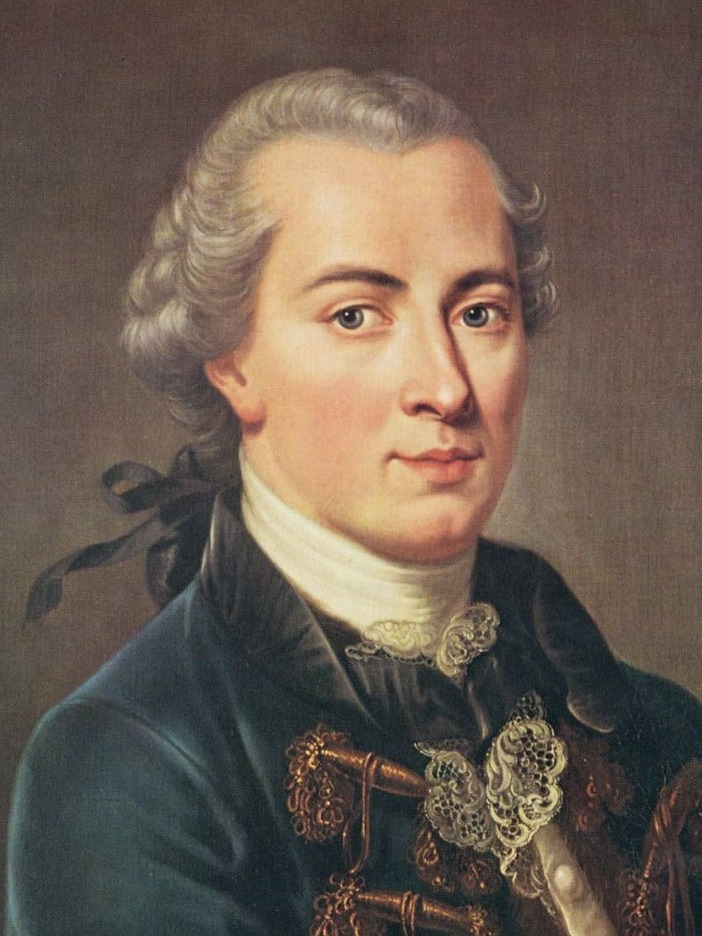
Immanuel Kant (1724–1804)
Kant spent his life in Königsberg, in Prussia. He began as a follower of the rationalist philosophy of Leibniz and Wolff, until, as he later said, David Hume woke him from his “dogmatic slumber.” The Critique of Pure Reason (1781) changed the course of European philosophy.
The limits of reason. Knowledge requires material given in experience and concepts that organize it. Reason goes wrong when it uses its concepts beyond any possible experience and claims to know about God, the soul, or the universe as a whole.
Appearances and things in themselves. We know the world only as it appears to us, structured by space, time and the mind’s own concepts. What things are in themselves lies beyond our knowledge.
The failed proofs of God. Kant concludes that the ontological, cosmological and design arguments all fail.
Making room for faith. Kant was not an atheist. He says he had to deny knowledge in order to make room for faith, and in the Critique of Practical Reason (1788), God is something moral life requires us to assume, although we cannot know it.
G. W. F. Hegel (1770–1831), unnamed. Hegel is not mentioned, but the second half of the paragraph uses ideas closely associated with him: a distinction between understanding and a deeper reason, an Infinite present within finite things, concepts as “moments” of a larger movement, and a seed already containing the tree. Reading this as Hegelian is an interpretation, but a natural one.
Kant and Ghazali compared
| Kant | Ghazali | |
|---|---|---|
| What he attacked | Pre-Kantian German rationalism | The “proud but shallow rationalism” in the world of Islam |
| His method | A critique of reason’s limits | Philosophical scepticism |
| Can God be known? | Not through theoretical reason | Yes, through mystic experience |
| What he left religion | Moral faith | An “independent content” |
The Ideas
Rationalism in eighteenth-century Germany (page 7). Enlightenment thinkers first offered reason as a support for religion. As critics tested doctrine and scripture by reason, more and more of it was rejected.
Dogma (page 7). Doctrines held on religious authority, which reason cannot demonstrate.
The utilitarian view of morality (page 7). Treating right and wrong in terms of usefulness or happiness.
Analytic thought (page 8). Thinking that proceeds by breaking things down and drawing out what follows. It has no connection to “analytic philosophy” in the modern sense.
Finitude and the Infinite (page 8). Finite things have limits, and the Infinite has none. The question is whether limited human thought can reach the Infinite.
Serial time (page 8). Time as one thing after another, like Bergson’s clock time.
The logical understanding (page 8). The ordinary working of the mind that sorts things into separate items. German philosophy calls this Verstand, and it contrasts with a deeper reason (Vernunft).
Fictitious unities (page 8). Generalizing by resemblance gives us a word like “tree,” but the word does nothing to connect actual trees.
Immanent Infinite (page 8). An Infinite present within things and within thought, in contrast to a reality standing far above us at the top of a ladder.
Moments (page 8). Hegel’s term for stages or aspects that have meaning only within a larger process.
Preserved Tablet (page 9). Al-Lawh al-Mahfuz, a Quranic term (85:22) for the heavenly record, used here as a metaphor for the whole of possible knowledge.
“Reciprocally exclusive” (page 9). Finite things in nature shut each other out, since two bodies cannot occupy the same place. Thought can take in what is other than itself.
Two traps
“Intuition” in Kant and in Iqbal. For Kant, intuition (Anschauung) means what is given to the mind in sensory experience. For Iqbal, it means direct knowing of Reality. Kant denies that humans have the kind of intuition Iqbal is defending.
Two meanings of “thought.” The paragraph criticizes thought and defends it in the same breath. What fails is the logical understanding. What succeeds is thought “in its deeper movement.”
Iqbal’s text
Read the paragraph now. The small numbers in the margin are the book’s page numbers.
7It cannot, however, be denied that Ghazali's mission was almost apostolic like that of Kant in Germany of the eighteenth century. In Germany rationalism appeared as an ally of religion, but she soon realized that the dogmatic side of religion was incapable of demonstration. The only course open to her was to eliminate dogma from the sacred record. With the elimination of dogma came the utilitarian view of morality, and thus rationalism completed the reign of unbelief. Such was the state of theological thought in Germany when Kant appeared. His Critique of Pure Reason revealed the limitations of human reason and reduced the whole work of the rationalists to a heap of ruins. And justly has he been described as God's greatest gift to his country. Ghazali's philosophical scepticism which, however, went a 8little too far, virtually did the same kind of work in the world of Islam in breaking the back of that proud but shallow rationalism which moved in the same direction as pre-Kantian rationalism in Germany. There is, however, one important difference between Ghazali and Kant. Kant, consistently with his principles, could not affirm the possibility of a knowledge of God. Ghazali, finding no hope in analytic thought, moved to mystic experience, and there found an independent content for religion. In this way he succeeded in securing for religion the right to exist independently of science and metaphysics. But the revelation of the total Infinite in mystic experience convinced him of the finitude and inconclusiveness of thought and drove him to draw a line of cleavage between thought and intuition. He failed to see that thought and intuition are organically related and that thought must necessarily simulate finitude and inconclusiveness because of its alliance with serial time. The idea that thought is essentially finite, and for this reason unable to capture the Infinite, is based on a mistaken notion of the movement of thought in knowledge. It is the inadequacy of the logical understanding which finds a multiplicity of mutually repellent individualities with no prospect of their ultimate reduction to a unity that makes us sceptical about the conclusiveness of thought. In fact, the logical understanding is incapable of seeing this multiplicity as a coherent universe. Its only method is generalization based on resemblances, but its generalizations are only fictitious unities which do not affect the reality of concrete things. In its deeper movement, however, thought is capable of reaching an immanent Infinite in whose self-unfolding movement the various finite concepts are merely moments. In its essential nature, then, thought is not static; it is dynamic and unfolds its internal infinitude in time like the seed which, from the 9very beginning, carries within itself the organic unity of the tree as a present fact. Thought is, therefore, the whole in its dynamic self-expression, appearing to the temporal vision as a series of definite specifications which cannot be understood except by a reciprocal reference. Their meaning lies not in their self-identity, but in the larger whole of which they are the specific aspects. This larger whole is, to use a Quranic metaphor, a kind of 'Preserved Tablet', which holds up the entire undetermined possibilities of knowledge as a present reality, revealing itself in serial time as a succession of finite concepts appearing to reach a unity which is already present in them. It is in fact the presence of the total Infinite in the movement of knowledge that makes finite thinking possible. Both Kant and Ghazali failed to see that thought, in the very act of knowledge, passes beyond its own finitude. The finitudes of Nature are reciprocally exclusive. Not so the finitudes of thought which is, in its essential nature, incapable of limitation and cannot remain imprisoned in the narrow circuit of its own individuality. In the wide world beyond itself nothing is alien to it. It is in its progressive participation in the life of the apparently alien that thought demolishes the walls of its finitude and enjoys its potential infinitude. Its movement becomes possible only because of the implicit presence in its finite individuality of the infinite, which keeps alive within it the flame of aspiration and sustains it in its endless pursuit. It is a mistake to regard thought as inconclusive, for it too, in its own way, is a greeting of the finite with the infinite.
How Iqbal Uses Them
He gives both men credit. Ghazali’s mission was “almost apostolic,” like Kant’s. Each broke an overconfident rationalism that religion could not survive, although Ghazali’s scepticism “went a little too far.”
He marks where they part. Kant could not affirm a knowledge of God. Ghazali found an independent content for religion in mystic experience, securing its right to exist apart from science and metaphysics. Iqbal counts this as a real achievement.
He names their shared mistake. Both took thought to be essentially finite. Ghazali’s experience of the Infinite only confirmed this for him, and it drove him to draw “a line of cleavage between thought and intuition.” Thought only appears limited, Iqbal says, because it works through serial time.
He redefines thought. The logical understanding can only sort and generalize. Deeper thought already contains the Infinite and unfolds it in time, as a seed contains the tree. Here he uses language close to Hegel’s, and he gives the idea a Quranic name, the Preserved Tablet.
He delivers what the first paragraph promised. There, thought and intuition were said to share a root. Here is the argument: if thought itself reaches toward the Infinite, it is not cut off from intuition. Thought too is “a greeting of the finite with the infinite.”